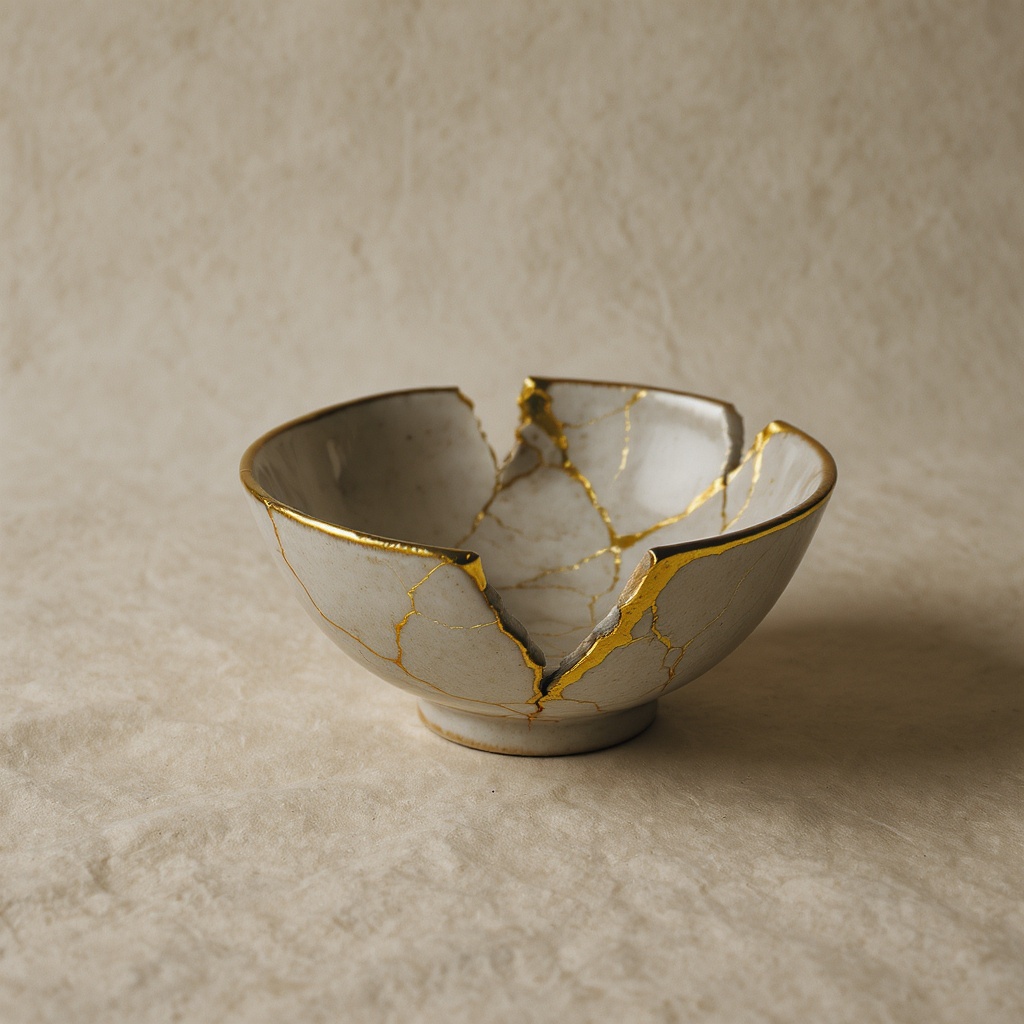
Kintsugi and Redemption
The Japanese art of mending broken things with gold meets the Christian claim that your cracks are where grace enters.
There is a ceramic bowl in the Kyoto National Museum that I have never seen in person, but I have thought about more than most things I have touched. It was dropped in the 15th century. Someone — a craftsman, a monk, an unknown person — did not throw it away. Instead, they gathered the shards, mixed lacquer with gold dust, and put the bowl back together. Not to hide the break. To honor it.
The seams that resulted are not scars. They are veins. They are the reason the bowl is famous. It is more beautiful broken and mended than it ever was intact. That is the entire philosophy of kintsugi — 金継ぎ — the Japanese art of repairing with gold.
The Cracks Are Not the Problem
Western consumer culture has done an extraordinary job of selling us the opposite. The seamless image. The flawless surface. The unedited life. We spend real money on filters, fillers, and the particular kind of silence that comes from pretending our damage doesn't exist.
Kintsugi refuses this. It says: the break is part of the object now. The repair is part of the history. You do not get to erase what happened — not because the gold can't fill the crack, but because the crack is the proof that something happened worth mending.
I think about this when I think about the Christian doctrine of redemption. Not the sanitized version — the one that comes in greeting cards and feels like a participation trophy. I think about the raw version, the one that sits in Romans and doesn't flinch: "We know that our old self was crucified with him in order that the body of sin might be done away with, so that we would no longer be slaves to sin."
That is kintsugi language. The old self — the broken one, the cracked one — was put on the cross. Not erased. Crucified. And from that death came something that, in the theology of the thing, is more beautiful than what came before.
"The break is not a disqualification. It is the point where grace enters."
Grace Doesn't Erase — It Illuminates
The problem with a lot of Christian teaching — and I say this as someone who has sat in a lot of it — is that it spends too much time on what is being forgiven and not enough time on what is being made. Forgiveness is negative space. Redemption is the painting that fills it.
Kintsugi is not primarily about repair. It is about making the repair beautiful. The gold lacquer that fills the crack is not just structural. It is aesthetic. It is a choice to make something extraordinary from what was broken. The Japanese craftsman who first did this understood something that the Christian tradition sometimes loses: grace is not subtle. Grace is gold in the crack.
2 Corinthians 4:17 — "For our light and momentary troubles are achieving for us an eternal glory that outweighs them all." — is not about minimizing the trouble. It is about saying that the repair is worth more than the original object ever was. The glory that results from the mending outweighs the moment of breaking.
Your Brokenness Is the Signal
Here is where this becomes personal, and I don't apologize for that.
There is a version of shame that says: you broke, therefore you are broken. That is a false reading. That is a reading that stops at verse one and never gets to the part where something happens. The shame reading is what the enemy wants — it keeps you looking at the crack instead of the gold.
The kintsugi reading says: the crack is where the light enters. Not where the light is blocked. Not where you failed. Where the light enters. It is the access point. It is the seam where something got in that wasn't there before.
What you survived — the loss, the failure, the fracture — is not the disqualifying feature of your story. It is the defining feature. It is the gold seam in your life that says: this person was broken and did not break permanently. This person was shattered and did not stay shattered.
"What you survived is not the disqualifying feature of your story. It is the gold seam."
The Garment as Symbol
When we designed the Kinshin pieces — the hoodie, the tee, the crewneck — we put the gold seam on the sleeve. Not as decoration. As declaration. We were saying: this piece was designed in reference to a philosophy that treats your damage as evidence of your capacity to be remade.
The gold thread on the seam is a signal, not a slogan. It does not explain itself. You have to ask. And when you ask, you get to hear why someone wearing it thinks your cracks might be the most beautiful part of you.
That is what kintsugi is asking. Not to be fixed. To be made beautiful. Not to go back to what you were before. To become something that couldn't have existed without the break.
What the Bowl Says
The bowl in the Kyoto National Museum has survived five hundred years. It survived a fall, a mending, and every person who has looked at it and understood something about themselves in the looking. It is worth more now — far more — than it was the morning before it broke.
Not because someone threw gold at it. Because someone understood what the gold was for.
The break was not the end of the story. It was the turning point. And if you are reading this and you feel like something in you broke — quietly, privately, in the part of you that no one sees — I want to tell you what the bowl knows.
You are not less. You are more. Not after the mending. In the mending. The gold goes in where the crack was. And the result is something that no one who has not been broken can make.
The seam is the story. Wear it.
The seam is the story.
Wear the seam — Drop 001 →
Restored Hoodie · Gold Seam Tee · Mended Vessel Crewneck. Made to order. Ships in 2–3 weeks.